Product Design · Development · Research · 2025
A Better Summer
Designing a platform for connection, routine, and meaningful activity during school breaks.
Started at
2025 Handong HTHT Hackathon
Tools
Figma · FlutterFlow · Firebase Studio
Recognition
Excellence Award
01 · Overview
What if summer break felt less empty?
This project began with a problem I saw among teenagers during school breaks: daily routines often collapsed, study habits became harder to maintain, and long stretches of free time could create feelings of emptiness and disconnection.
Our goal was to build a platform that could help teenagers create meaningful goals, introduce small changes into repetitive days, record their experiences, and stay connected with others.
The project began at the 2025 Handong University High School HTHT Hackathon, where we developed the idea and an MVP. It later continued as a deeper research project at our school's academic festival.
02 · The Problem
The problem was not simply having too much free time.
We surveyed 68 students from grades 7 through 12. About 80% reported experiencing feelings of emptiness or disconnection during school breaks.
Their responses pointed to several recurring causes: repetitive daily routines, a lack of communication with others, and the absence of concrete goals or a sense of achievement.
This changed how we approached the problem. Instead of building another productivity tool focused only on studying, we began thinking about four ideas together: connection, recording, achievement, and unusual activities that could add variation to an otherwise repetitive day.
~80%
of the 68 surveyed students reported experiencing emptiness or disconnection during school breaks.
03 · Designing the Solution
Structure without making summer feel like another school day.
We wanted participation to feel voluntary and enjoyable rather than forced. One idea was to recommend small, unusual activities such as reading on a bus or writing at a café—simple changes that could interrupt repetitive routines.
We also decided against an open-chat structure with large groups of strangers. We thought that could create a higher barrier to communication, so we designed a community-code system that would allow users to form safer, more intentional groups.
01
Goals & Daily Tasks
Separate long-term break goals from smaller daily tasks to support self-directed routines.
02
Groups
Create public or private groups around shared interests such as studying, exercise, or exam preparation.
03
Record
Capture experiences through photos and notes about thoughts and emotions.
04
Share
Share experiences within feeds or groups to create a stronger sense of connection.
Figma Prototype · v1.0
Mapping the first product experience.
The initial Figma prototype mapped how users could move from onboarding and break-goal setting into daily tasks, groups, personal records, and shared spaces.
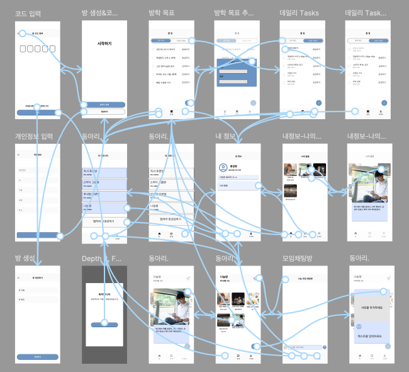
Early Figma prototype showing the navigation and interaction flow between the platform's core features.
04 · Building the MVP
The development process changed as much as the product did.
Week 1
Problem & Research
Defined the idea, conducted the student survey, and analyzed the problem.
Week 2
Figma · v1.0
Visualized the first UI prototype, including community creation and goal-setting flows.
Week 3
FlutterFlow
Attempted to develop the application in FlutterFlow, but paused after encountering learning-curve and functionality limitations.
Week 4
Firebase Studio · v2.0
Changed development tools and successfully implemented onboarding and core product functionality.
05 · What Changed
Changing tools became part of the project.
One of the most important moments came when our original development approach stopped working. We had planned to build the application with FlutterFlow, but its learning curve and functional limitations made it difficult to continue as planned.
Rather than remaining attached to the original tool, we switched to Firebase Studio. That decision allowed us to move from a prototype toward a working implementation of the onboarding process and core features.
Our team also changed from five members to three during the hackathon. Adapting to both the smaller team and a new development environment became an important part of the experience.
The project showed me that building something does not always mean following the original plan. Sometimes progress depends on recognizing when an approach is not working and changing it.
06 · From Product to Research
The hackathon raised questions that the prototype alone could not answer.
After the hackathon, I continued the project through the school academic festival. The focus expanded from building features to asking why those features might matter.
I reviewed academic literature related to adolescent well-being during school breaks. The research suggested that negative and positive emotional experiences within particular activity contexts may matter more than the amount of time spent studying or relaxing by itself.
I also examined research on self-esteem and peer attachment. Higher peer attachment was associated with higher self-esteem and acted as an important protective factor against adolescent depression. This provided a research basis for exploring recording, sharing, and group communication as central parts of the platform.
Alongside the literature review, I analyzed our survey results and ten existing productivity applications to develop hypotheses about the platform's user experience.
07 · Next Steps
From an MVP toward something that can actually be tested.
The next stage is to develop the Figma and Firebase Studio MVP further and conduct beta testing with students at my school.
The plan is to use pre- and post-surveys and in-depth interviews to examine changes in users' feelings of emptiness and their ability to achieve goals during the break.
Feedback from this testing would then be used to refine the system into a v3.0 structure designed with users beyond the school community in mind.