YOONCHAN WRITES / ESSAYS & PROSE
September 9, 2025
Short Reflection
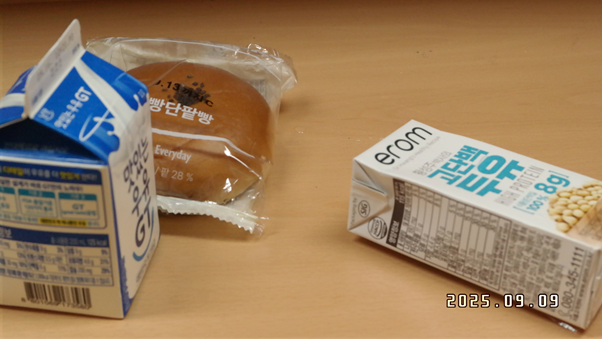
Happiness can be found in a single sweet red-bean bun and a carton of soy milk. It is there in eating the bread I brought in the morning after exercising; in studying while chatting with friends at just the right level of noisiness; and in taking a break from hard work to enjoy a book I have been wanting to read.
Happiness is nothing grand. If there is one truth I have learned in my short seventeen years of life, it is that happiness is everywhere. We do not have to go looking for it. The need to do so approaches zero. Happiness is all around us; we are simply too blind to notice it.
Perhaps we are too overwhelmed by reality. We are too tired to be happy. So sometimes it is good to tell yourself, 'It's okay.' When studying suddenly makes you angry, it is fine to say a prayer and go to sleep. It is fine to set aside a whole day to rest at home, or to go see a movie alone that you have been wanting to watch.
We do not endure all this suffering in pursuit of some enormous happiness. We simply find happiness along the way.
“I have worries, too. You see, I cannot see water. I think I am beginning to understand, a little, what it means to say that what truly matters is invisible to the eye.”
They say that what truly matters is invisible to the eye. Just as a dragon cannot see the rock, a tiger cannot see the paper covering a traditional window, and a carp cannot see water, the things that matter most to us are said to be invisible. Why? What is this 'thing that truly matters,' and why can it not be seen?
An entity simply exists. The rock, the window paper, and the water simply occupy their places in the world. In themselves, one might say, they have no meaning. Their meaning emerges through interactions with other beings. This is how I have understood the phrase 'existence precedes essence.' Existence is simply being; essence is the meaning of that being. To me, what truly matters is the meaning that something possesses within the world. For a carp, river water means life. One might call this the 'essence' Sartre spoke of. And since existence precedes essence, we must understand existence before we can understand essence. We must know its origin, for essence arises from existence. To see essence, to see what truly matters, we must first see what exists. This is why the golden carp could not fully grasp the essence of water: it could not see water as an entity. By contrast, the carp understood the existence of the window paper and the child inside the room, as well as their relationship to the tiger, and could therefore ask a question that penetrated to the essence of the window paper. There is only one conclusion: to see what truly matters, we must first recognize its existence.
“If you gaze long into an abyss, the abyss also gazes into you.”
How beautiful would a single ray of light be in an abyss of utter darkness? How precious would it be for eyes perfectly accustomed to the dark to be overwhelmed by pure white light?
Life in this world can be terribly empty and dark. Behind the visible face of the world lurks a darkness capable of swallowing us with ease. As the saying goes, 'If you gaze long into an abyss, the abyss also gazes into you.' The abyss we confront is more than capable of consuming us.
Yet that does not mean we can deliberately avoid it. Sometimes we must drive ourselves into the wilderness. When we confront the abyss of the world, and the abyss within ourselves, we may discover a single ray of light there. That light will guide us toward transcendence and help us live as lights in the world.
Of course, choosing to confront the abyss is never easy. In its seemingly endless depths, we may fear that we will not find even a thread of hope. But will you live so naively, turning away from the darker side of the world? To become a truly great and noble human being, we need the courage to gaze into that abyss. How beautiful the ray of light we find there will be. We must carry that light within us. And, little by little, we must become stars ourselves.
Take the Long View of Learning, and of Life
Our lives are long. To those of us living as the subjects of our own lives, life can feel almost absurdly long. And though we grow at different speeds, each of us develops over that long span. We are different species of trees. There is no one who does not grow. Everyone breathes, and everyone bears witness to their own existence.
When seeking to affirm our existence, we must remember above all that life is long. Rather than merely announcing our existence for a fleeting moment, what truly matters is knowing that we exist—knowing it ourselves. Not someone else, but I must recognize my own existence. The desire to prove ourselves is natural. Yet eventually we must realize how superficial that desire can be. Only when I accept and understand myself can I truly *be*. I must be myself. Even the Korean word for 'beautiful,' *areumdapda*, has been associated with *areum*, meaning 'self.' What am I, and what will I become? These are questions we must embrace throughout our lives. As the proverb goes, a tiger leaves its skin when it dies, and a person leaves a name. What kind of name will I leave behind? What will people feel when they speak my name, and how should I live to make that possible? These are the questions I ponder this evening.