YOONCHAN WRITES / PHILOSOPHICAL WRITING
TOK Exhibition: The Limits of Knowledge
Philosophical Writing
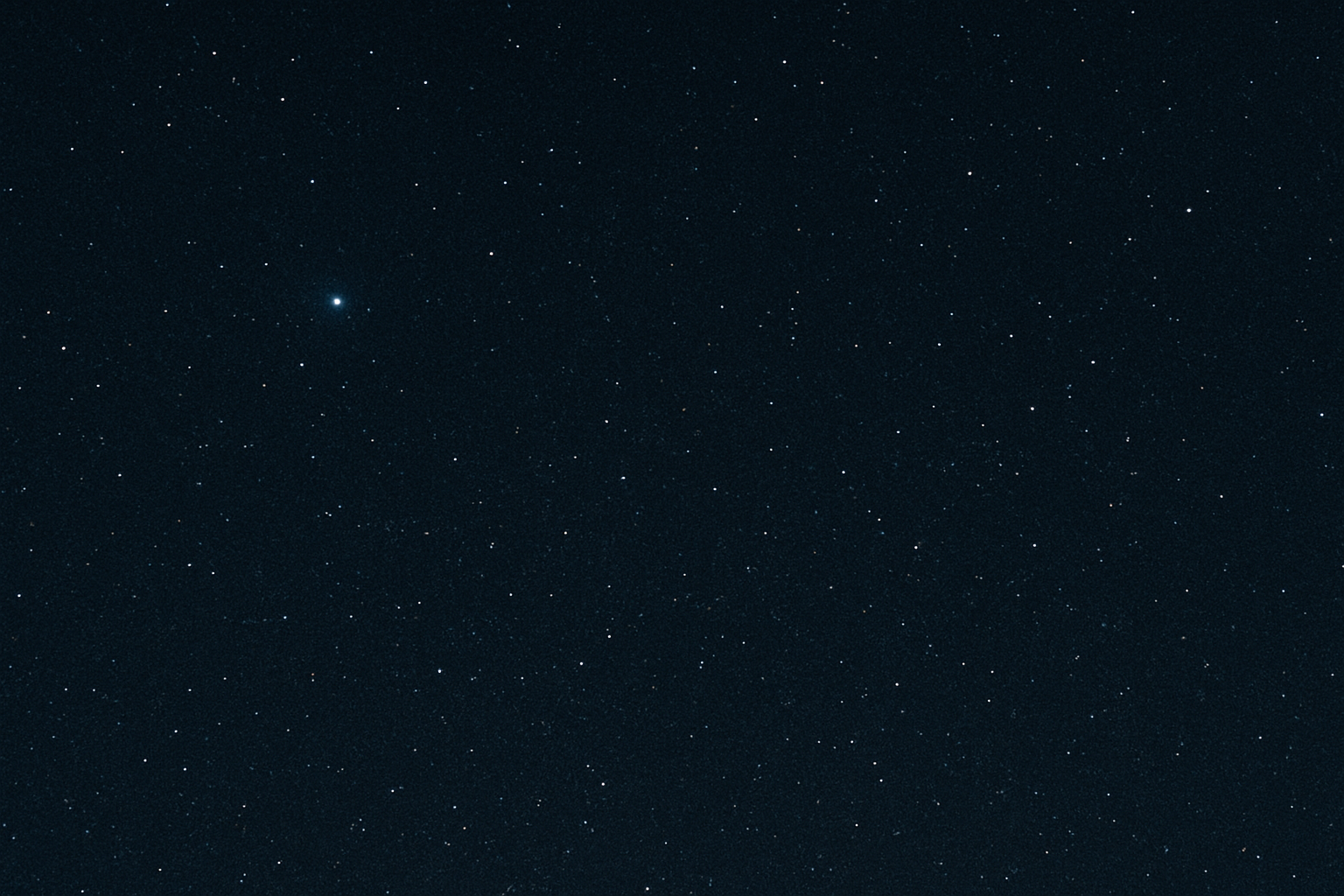

The photograph above is one I took myself of the sky—or, more broadly, of space. It shows numerous stars and the vastness of the universe. We can observe some of the general features of the stars and of space itself. We can see that space is mostly dark and that it contains an innumerable number of celestial bodies. Furthermore, we can estimate the approximate size of the observable universe and even the number of stars within it. All of this knowledge can be obtained or inferred through observation and speculation. Some kinds of knowledge are regarded as highly certain: there is strong evidence to demonstrate that they are true. Other kinds are considered only possible answers among competing explanations. Such claims are not absolute, but they possess some degree of justification supported by evidence. Examples include the Big Bang theory and the cosmic microwave background. More importantly, however, some questions cannot be settled through observation and technology at all. A prominent example concerns the birth of the universe and what preceded it. Humanity cannot know, or even provide information about, that time. There is no evidence concerning what came before our universe. No observations of that time have been made, nor has technology developed sufficiently to produce such information. Therefore, we cannot know what happened. Unlike the Big Bang theory, claims about the period before the universe began have no available evidential basis; they represent a kind of knowledge that cannot be acquired. Unless extraordinary technological breakthroughs occur, we will be unable to produce knowledge of that time. This is a clear limitation of science and its methods. To claim to know something, science requires evidence and reasoning. If a claim lacks either, it cannot count as scientific knowledge. Since evidence and reasoning depend on technology and observation, their limitations leave certain things beyond our knowledge.
The photograph above shows my Bible. Having been a Christian throughout my life, I believe that science can neither confirm nor refute the Bible. Science has no methodology with which to evaluate knowledge in the domain of religion. This is because the kinds of knowledge investigated by science and religion are fundamentally different. The two fields address entirely different questions. In this context, even the greatest scientists did not necessarily deny the existence of God or the supernatural; they simply did not hold a particular faith. The American biologist Stephen Jay Gould once argued that the domain of science concerns the empirical world, while the domain of religion concerns meaning and moral values. This suggests that science and religion occupy fundamentally different domains and employ fundamentally different methodologies. Whereas natural science relies on observation, reasoning, evidence, and logic, religion rests on individuals' faith. If a person loses that faith, religious knowledge loses its legitimacy for that person. In this respect, whether Jesus existed as a historical person is not, in itself, a question of religious knowledge: Christians generally accept his historical existence, but the question is closer to one of history. Whether Jesus is the Son of God, by contrast, is a question of religious knowledge, since it has been the subject of numerous debates grounded in faith and doctrine. Science and history may investigate evidence for Jesus's existence, but they cannot settle whether God created the universe. A familiar saying captures this distinction: “Science asks how; religion asks why.” Science seeks to discover and understand the nature of the universe and how it operates. Religion, by contrast, comprises people's beliefs concerning the divine. Because their origins, natures, purposes, and methods differ, science and religion cannot adjudicate each other's knowledge claims. Religious knowledge cannot be “known” through the methods of natural science. Ultimately, the meaning of “to know” differs between the domains of science and religion. In conclusion, when different domains investigate fundamentally different kinds of knowledge, some things remain unknowable from the standpoint of another domain.