YOONCHAN WRITES / RESEARCH
The Economic Effects of Minimum Wage Increases
IB Economics Commentary · Microeconomics
The federal minimum wage in the USA of $7.25 has not changed for 15 years. While the need for a minimum wage increase has been proposed, 21 states in the USA have increased their minimum wages. This policy is to resolve wage inequality and to help minimum wage workers cope with inflation. Economic well beings of low paid workers will be ensured. It is expected to have an impact on 9.2 million workers and raise pay by a total of $5.7 billion. Women, Black and Hispanic workers will benefit the most from the increase. The change in minimum wage is expected to trigger various changes in other parts of the economy. This commentary will be analyzing the effects of the increase.
One of the positive effects of minimum wage increase is that the overall market demand of normal goods increases. The graph below shows the change in the D curve. (Figure 1)
Figure 1: The Market for Normal Goods
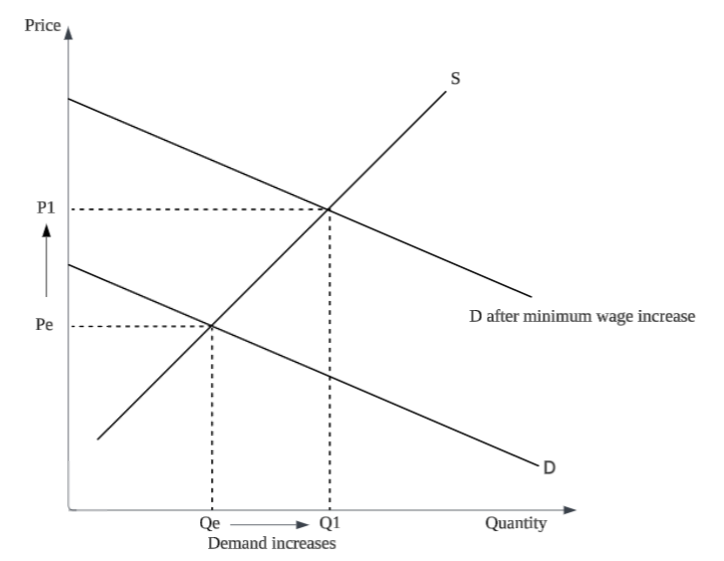
The original equilibrium of Pe and Qe shifts to a new equilibrium of P1 and Q1, since the D curve shifts to the right. Consumption of normal goods rises as income rises, so the markets for normal goods expand. The area of consumer surplus also expands.
Another benefit is that as well as helping the minimum wage workers to keep up with inflation and rising housing prices, it also can ease income inequality. Essential living expenses could have been burdensome for minimum wage workers to afford. Research held by Drexel University found out that ‘a true living wage’ would be between $20 and $26 per hour depending on the state. The policy is expected to resolve this matter. Also, in the long run, the policy could help reduce government welfare expenditures.
Overall, if conducted well, the change in the minimum wage can be beneficial to both the government and the workers, ensuring their well being.
The most important negative effect is that the unemployment rate might increase. In the labor market, the workers produce labor, and the firms demand labor. So when the minimum wage increases, at least in the minimum wage labor market, the government has set a price floor. Price floor, when binding, is known to cause oversupply. Oversupply, or excess supply, can affect the market by deepening unemployment problems. As the ‘price’ of the workers rises, firms may reduce employment. (Figure 2)
Figure 2: Minimum Wage Labor Market
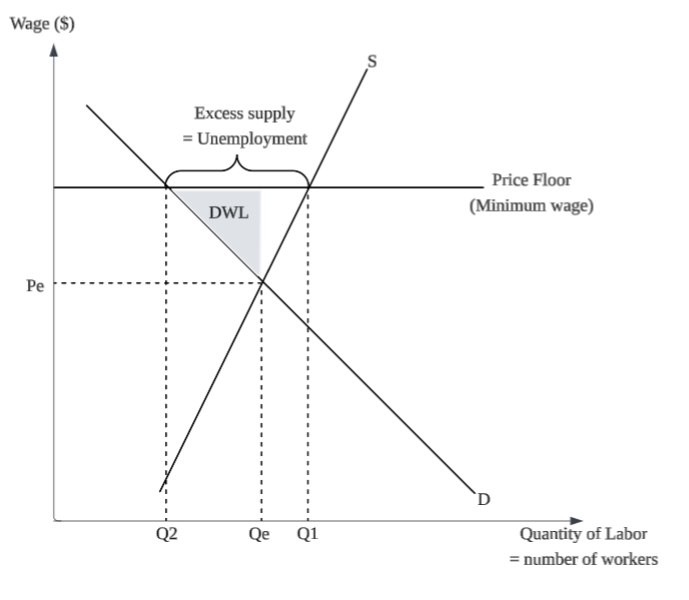
The original equilibrium was formed at Pe and Qe, but after the minimum wage increase which sets the price floor, oversupply of the amount of ‘Q1- Q2’ occurs. These people lose their jobs, increasing the unemployment rate. This can have various effects on the economy.
Deadweight loss is also one of the effects that should be considered. The shaded region in the diagram represents the DWL (Deadweight Loss), which is caused by the price floor. The DWL shows the lost economic value from transactions that could have happened.
Also, income will fall when people lose their jobs, and demand will actually decrease. This leads to the opposite effect from what was originally expected.
Another side effect is that in the short run, it is highly likely that inflation might get worse, since the money supply will increase. This also means that it wil get harder for the low wage workers to keep up with rising living expenses. These side effects will have a negative impact on the workers, infringing their well being.
But it is also important that the effects of the minimum wage increase is limited, since only the minimum wage workers are affected. Also, there surely exists limitations of this analysis. The changes in a longer period of time were not fully considered. Economies tend to change additionally over time, but it was not sufficiently reflected. Also, this analysis lies on ‘ceteris paribus’, which simplifies most of other real-life interactions. It is an important assumption in economics, but all dynamics have not been considered as needed. Various conditions have been ignored, and the issue of minimum wage increase is a highly complex matter in real life. As the policy is directly related to the problem of economic well being of minimum wage workers, all aspects must be fully considered.
Although the effects of a minimum wage increase are complex, deliberate implementation can help maximize benefits while minimizing side effects such as unemployment.