YOONCHAN WRITES / RESEARCH
China’s Trade-In Policy and Domestic Consumption
IB Economics Commentary · Macroeconomics
China’s domestic market has been sluggish, primarily caused by a downturn in the real estate sector and low consumer confidence. As a solution, the Chinese government introduced the ‘Trade-in’ program, where the government subsidizes consumers who replace their old products with new, high-efficiency products. This is an attempt to boost domestic consumption, involving a huge amount of the government budget. The total amount of budget allocated for the policy is up to 300 billion yuan, which is double the amount from the previous year. And importantly, even though the local governments are having trouble with fiscal deficits, they have to cover 10% of the budget.
The most relevant key concept is ‘intervention’, since the Trade-in policy is one of the most direct ways of intervening in the market. This commentary will examine both the positive and the negative aspects of the policy.
One advantage of the policy is that it actually boosts consumption, at least in the short run. As disposable income increases for consumers, the AD curve of the entire market will shift to the right, forming a new equilibrium. Consumption rises as income rises, increasing the GDP. GDP is composed of various factors, which include ‘consumption’ and ‘government spending’. Since the policy utilizes the government budget and subsequently stimulates consumption, it could be said that the policy contributes to the GDP.
Also, in the long run, it will cause inflation, but in this case, this inflation would be beneficial to the economy. This is because the government is trying to prevent deflation caused by weak consumption in the first place. This type of expenditure is called ‘transfer payments’. The 300 billion yuan allocated in the budget would cause mild inflation. This can be shown in a diagram. (Figure 1)
Figure1. <Keynesian Diagram of The Entire Market After the Trade-In Policy>
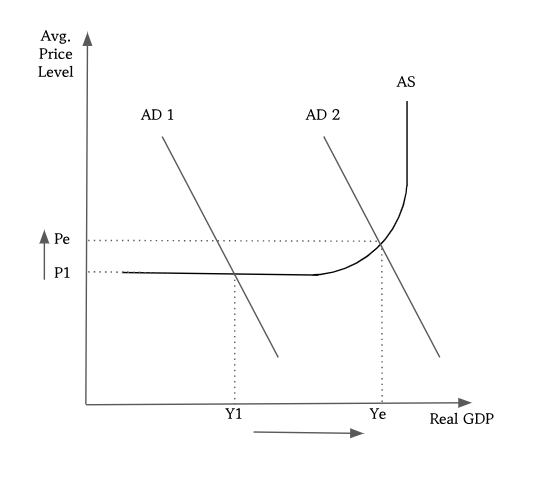
As the AD 1 curve shifts to the right and becomes the AD 2 curve, a new equilibrium of Pe and Ye is formed, and the economy gets closer to the full potential output. This leads to an increase in Real GDP and a moderate rise in the average price level. This inflationary pressure is actually beneficial, helping the economy to cope with deflation while boosting output.
However, there are also several drawbacks of the policy. First, the policy actually failed to address the essential problem of downturn in the real estate sector and low consumer confidence. The policy almost solely aims to boost consumption, so it would have little effect in resolving the essential causes. Thus the current problem of weak domestic consumption is highly likely to reoccur. Also, the demand may drop suddenly when subsidies expire.
Another defect of the policy is the fiscal burden of both the central and the local governments. Especially for the local governments, since they are already struggling with financial deficits, covering 10% of the budget would be a tremendous burden. This can act as a high opportunity cost for both the central and the local governments.
Furthermore, the GDP increase would partially cancel out because of the ‘crowding out effect’. (Figure 2)
Figure2. <Loanable Funds Market After The Trade-In Policy>
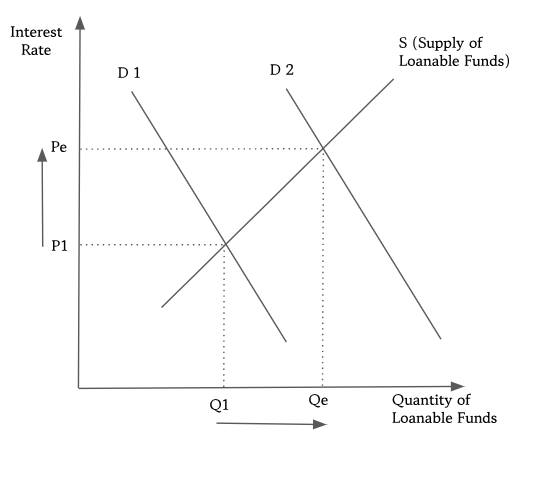
The diagram above is the loanable funds market. As the government borrows capital from the market, D1 curve shifts to the right and becomes D2, consequently forming a new equilibrium with a higher interest rate of Pe. Because the interest rates are the price of borrowing money, private investment contracts. Since private investment is one of GDP’s components, it may seem as if GDP is growing, and it would actually grow in the short run, but eventually it would mostly cancel out.
This commentary has thoroughly examined the Trade-in policy, but the policy’s real-world effects can be different from the theoretical evaluation.
First, the claim that the crowding out effect would cancel out the GDP growth is different from the empirical data. Even though I claimed that the interest rates will soar, China has been complementing the Trade-in policy with a monetary policy which keeps the interest rates low. Also, because business confidence has already been low, the crowding out effect will have little impact on the growth in GDP.
Furthermore, this report lacks sufficient numbers or quantitative analysis, since it is only based on the article itself and other analyses. More numerical data is needed for further examination.
In conclusion, although the effects of the Trade-in policy are complicated, deliberate implementation can help maximize benefits while minimizing side effects such as inflation and high opportunity costs. I concluded that this policy has more advantages than downsides and that it is going to be effective in the current situation. Thus if implemented well, it would have significant impacts on the economy.