YOONCHAN WRITES / RESEARCH
China’s Strong Yuan and Reserve Currency Ambitions
IB Economics Commentary · Global Economics
China is favoring a ‘strong yuan’. “Chinese President Xi Jinping has explicitly revealed his ambition to make the yuan a second key global reserve currency”, reported Chosun Daily. This is planned to be accomplished by the ‘posted exchange rate policy’ with a 2% trading band, a type of tightly managed float system.
The key concept most relevant is ‘intervention’, because China has become one of few countries intervening in the forex market. This commentary examines both the positive and negative aspects of this intervention.
The general effect of the policy is shown in the diagram below. The trading band is not considered for simplicity, and to show how artificially the government controls the rate. (Figure 1)
Figure1. <The Forex Market with the Posted Exchange Rate Policy>
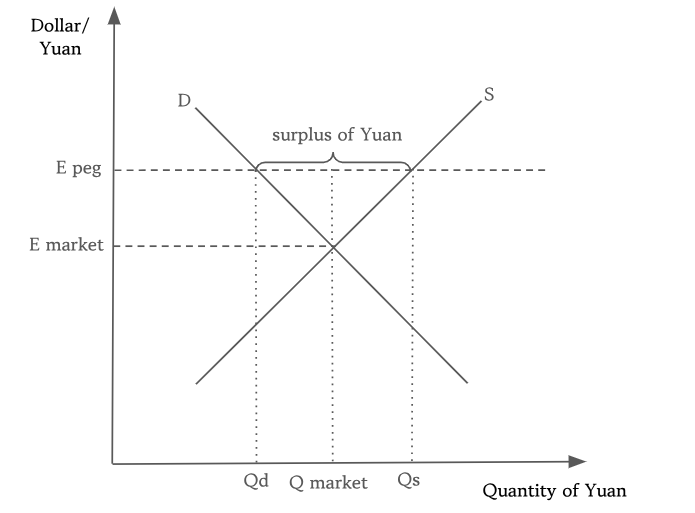
The exchange rate is pegged at Epeg. This causes a surplus of the yuan between Qd and Qs, which the government is responsible for absorbing through foreign exchange interventions. This means the government should buy the yuan and sell foreign currencies. The exchange rate will fall back to Emarket otherwise.
The most significant benefit of the policy is, as intended, helping the yuan to become a global reserve currency. Economic power and currency stability is required to achieve reserve status which encourages foreign investors and banks to increase their holdings of the yuan. Numerous benefits follow, such as lower borrowing costs, zero exchange rate risk, continuous capital inflows, and sustaining trade deficits.
Moreover, while the US dollar remains as the only reserve currency, China’s strategic intervention to revalue the yuan aligns with the Trump administration’s advocacy of a ‘weak dollar’ to move its trade deficit towards a surplus. This facilitates the yuan becoming stronger relative to the dollar, lowering the cost of importing crude oil even more since oil is only traded in dollars.
Following these, both the SRAS and LRAS increase as illustrated in Figure 2. (Figure 2)
Figure2. <The Entire Market with a Stronger Yuan>
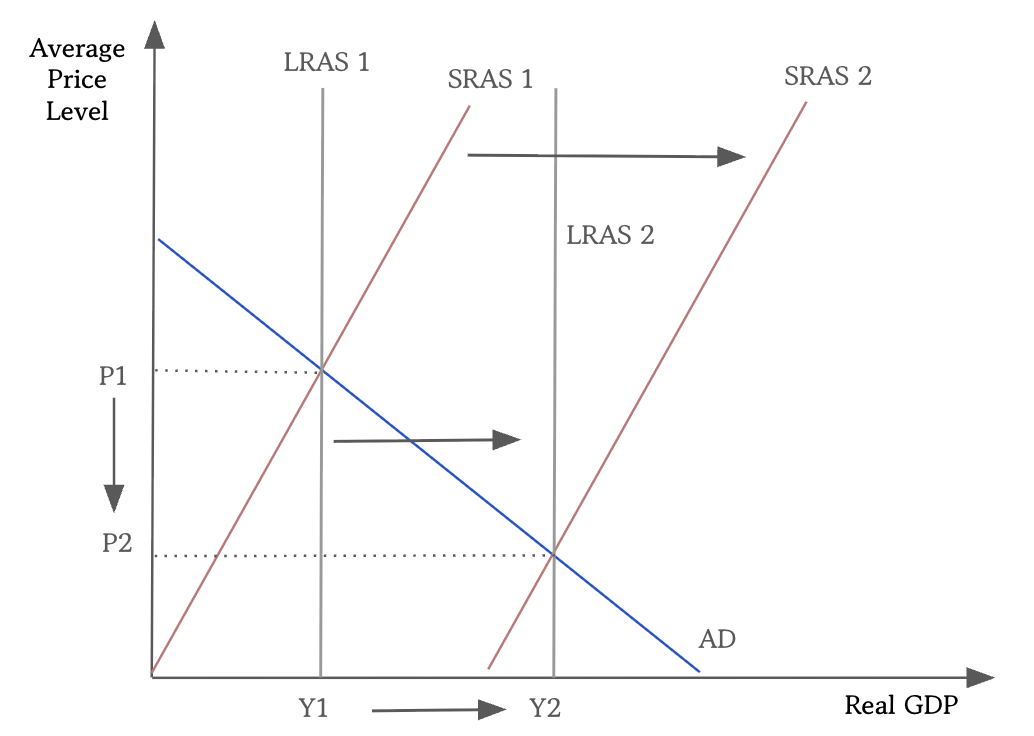
As the yuan is revalued, the costs of imports fall, including energy and raw materials. Decrease in input costs will lessen costs of production, causing SRAS1 to shift rightward and become SRAS2. Potential output increases from Y1 to Y2 because firms are able to reinvest more and import more capital goods, expanding the production possibility curve. A new equilibrium forms as deflationary pressure lowers the price level, while real GDP expands, indicating economic growth.
Intervention enables the government to artificially alter the economy, selectively favoring specific economic values: In this case, reserve status and cheap imports. This can practically facilitate economic growth.
However, despite these benefits, various drawbacks exist. First, a strong yuan causes exports to fall. AD decreases, dampening the rise in real GDP from Figure 2, although it is indeterminate whether the former will be greater than the latter. This is especially detrimental to China’s export-dependent economy as a manufacturing country.
This drop in export decreases the demand for the yuan, shifting the demand curve leftward from D1 to D2. (Figure 3)
Figure3. <Impact of a Strong Yuan on the Forex Market>
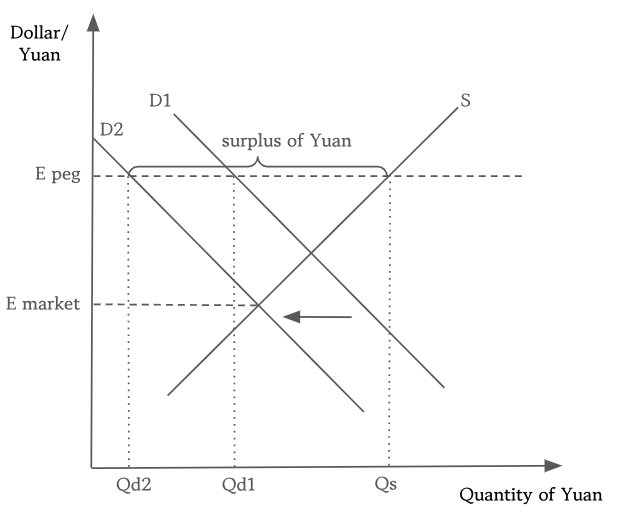
Consequently, the gap widens from Qd1Qs to Qd2Qs. The government will have to intervene more aggressively to maintain the exchange rate. Selling foreign currencies might cause a depletion of foreign exchange reserves.
Furthermore, considering the weak domestic consumption in China, pegging the exchange rate is especially harmful. The PBOC(People’s Bank of China) would not be able to lower the interest rate to stimulate domestic consumption because it causes the demand for the yuan to fall even more, widening the gap. This will be particularly burdensome for the government already aggressively intervening.
Finally, because this policy reduces liquidity and acts as a capital control, it keeps the yuan from becoming a global reserve currency. This is evident as the yuan's global reserve share fell from 2.9% to 1.9%. Experts also say that the euro, not the yuan, will fill the gap as the dollar's dominance weakens. This could undermine the expected advantages, showing that there is a limit to the extent to which the government can intervene in the market.
While real-world outcomes can be different from theoretical evaluations, this commentary acknowledges several limitations.
First, the analysis lacks specific comparisons between the magnitudes of the strong yuan policy's direct and indirect effects. Second, relying on a single article, the commentary needs more quantitative examination supported by external data.
Government intervention always causes tradeoffs, as it favors specific values over others. It enables the government to arbitrarily select which sector of the economy to develop by sacrificing others, such as short-term trade surplus and interest rates.
Conclusively, despite long-term benefits from revaluation and global reserve status, the policy poses significant short-term harm given China's economic traits. Therefore, alternative policies involving less intervention are recommended. A looser managed float system would allow the market to adapt better to exchange rate changes. And despite drawbacks like time lags or budget deficits, expansionary fiscal policies could be appropriate alternatives when monetary policy tools are limited.